The Longobards in Italy
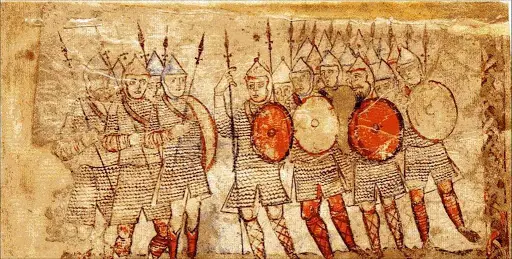
The Lombards (or Longobards) were a Germanic people who ruled much of Italy between 568 and 774. In little more than two centuries they left a deep mark on the peninsula: in its laws, its language, its place names, and in many castles and churches that still tell their story today.
Origins: from northern Europe to Pannonia
According to the tradition recorded by Paul the Deacon in his Historia Langobardorum (late 8th century), the Lombards came from Scandinavia. The first reliable historical records, however, place them in the 1st century AD along the lower Elbe, in what is now northern Germany. Their name, according to the same tradition, came from the warriors’ «long beards.».
Over the centuries they gradually moved south-east, through Bohemia and Moravia, until in the 6th century they settled in Pannonia, present-day western Hungary, along the middle Danube.
568: Alboin and the arrival in Italy
In 568, led by King Alboin, the Lombards crossed the eastern Alps and entered Italy through Friuli. Italy was emerging from the long and devastating Gothic War (535–553), and the Byzantine Empire was unable to mount an effective resistance.
The first duchy was founded at Cividale del Friuli. Within a few years the Lombards occupied most of the Po Valley: Pavia fell in 572 after a three-year siege and later became the capital of the kingdom. That same year Alboin was murdered in Verona in a plot hatched by his wife Rosamund. A decade without a king followed, the so-called Rule of the Dukes (574–584), during which power lay with the military leaders of the individual cities.
Langobardia Maior and Langobardia Minor
The Lombard conquest was only partial: the Byzantine Empire kept control of the Exarchate of Ravenna, Rome and Lazio, the coasts, and much of the South. Italy thus remained divided for centuries between Lombard and Byzantine territories, a split that long shaped the history of the peninsula.
The Lombard lands were organized into two large areas:
- Langobardia Maior, the kingdom proper, with its capital at Pavia, covering northern Italy and Tuscia, today’s Tuscany;
- Langobardia Minor, made up of the great duchies of Spoleto and Benevento in central and southern Italy, which enjoyed wide autonomy from the king.
The Lombards in Tuscany
In Tuscany the main center of Lombard power was Lucca, the seat of the Duke of Tuscia and one of the kingdom’s most important mints. Tuscany was also crossed by the Monte Bardone road, the route linking Pavia to Lucca and Rome while avoiding Byzantine territory, which would later become the Via Francigena.
According to several theories, some of Tuscany’s great feudal families descended from the Lombard aristocracy of Lucca, including the Aldobrandeschi, future lords of Maremma. Many place names in the region still carry Lombard traces, such as places called Fara, Sala, Gaggio or Cafaggio.
The law: the Edict of Rothari
In 643 King Rothari issued the Edict of Rothari, the first written collection of Lombard laws. Written in Latin, the edict set out the rules of community life and introduced, among other things, the wergild (guidrigildo), a monetary compensation that replaced private vengeance. The laws were later expanded by subsequent kings, especially Liutprand.
The height of the kingdom: Liutprand
The Lombard kingdom reached its peak under King Liutprand (712–744), who strengthened central power, curbed the autonomy of the duchies of Spoleto and Benevento and seized several territories from the Byzantines.
In 728, with the so-called Donation of Sutri, Liutprand gave the castle of Sutri and some villages in Lazio to the Pope: an episode regarded as the first nucleus of the future Papal States.
Culture and religion
Lombard culture was deeply rooted in Germanic traditions, but over time it merged with Roman and Christian culture. When they arrived in Italy, the Lombards were partly pagan and partly Arian Christians. The shift to Catholicism was gradual; it was encouraged by Queen Theodelinda, wife of King Agilulf and a close correspondent of Pope Gregory the Great, and was completed during the 7th century.
Conversion was decisive for the integration of Lombards and the Roman population. Its legacy can be seen in churches, monasteries, and outstanding works of art, from the Lombard Temple of Cividale to the Santa Giulia complex in Brescia and the Cathedral Treasury of Monza, associated with Theodelinda.
The end of the kingdom: Desiderius and Charlemagne
In the 8th century the Lombard kings tried to unify the peninsula. In 751, King Aistulf captured Ravenna, ending the Byzantine Exarchate. The threat to Rome, however, led the Pope to call on the Franks, who under Pepin the Short came down into Italy in 754 and 756.
The decisive blow came from Charlemagne, King of the Franks. In 773 he invaded Italy and besieged Pavia, which surrendered in 774: King Desiderius was taken prisoner, and Charlemagne took the title of King of the Lombards (rex Langobardorum). The kingdom was annexed to the Frankish realm, which in 800 would become the Holy Roman Empire.
Lombard history, however, did not end in 774. In the South the duchy of Benevento, turned into a principality by Arechis II, remained independent and later gave rise to the principalities of Salerno and Capua. These Lombard states survived until the 11th century, when they were conquered by the Normans.
The Lombard legacy
The Lombard legacy survived in Italian culture and institutions. The very name of the region of Lombardy comes from them, and many everyday Italian words are of Lombard origin, such as guancia (cheek), schiena (back), panca (bench), scaffale (shelf), zazzera (mop of hair) and stamberga (hovel).
Since 2011 the serial site “Longobards in Italy. Places of the Power (568–774 A.D.)” has been inscribed on the UNESCO World Heritage List. It includes seven sites: Cividale del Friuli, Brescia, Castelseprio-Torba, Spoleto, Campello sul Clitunno, Benevento and Monte Sant’Angelo.
Map of the main Lombard sites in Italy
The map shows the seven UNESCO sites and some of the main cities of the Lombard kingdom. Select a marker to read a short historical note.
Red markers show the sites of the UNESCO property “Longobards in Italy. Places of the Power”.
Conclusion
The Lombards played a crucial role in Italian history, not only as conquerors but as protagonists of a long process of cultural and political integration. Their laws, their language and the aristocratic families that grew out of their world helped shape medieval Italy, including the network of castles and lordships that would characterise Tuscany in the centuries that followed.