



How to reach
From Florence follow the Highway A1 toward Rome until the exit of Chiusi; from here, continue to Sarteano, then Cetona. Follow the SS321 to Piazze. The indication to Palazzone can be followed from here, and from this little hamlet, continue along the country road that brings you to Fighine. The same road can be taken on the opposite side of the mount from S.Casciano dei Bagni.
History
The castle rises in an exceptional strategic position, on the watershed between the valleys of the Paglia and the Chiana streams, at approximately 650 meters of altitude. Fighine was mentioned for the first time in 1058 in relation to the Parish church of Santa Maria 'de Fighine'. In the 12th century, the castle was a fief of the Visconti di Campiglia d' Orcia, a powerful family of this area, later a feudatory also of Chiusi, S. Casciano (now S.Casciano dei Bagni) and Celle sul Rigo.
We find Fighine as a fortified castle in the edict of 1266, with which the Emperor Frederick di Svevia granted to Tancredi, Viscount of Campiglia, the possession of Fighine and other castles. Also, Ludovico the Bavaro confirmed Fighine to the Viscount. The position made Fighine an object of disputes between captains of mercenary troops and the local nobility until it was occupied by the troops of Cortona and yielded by Paolo Orsini.
Between the successive owners there was also the 'Condottiero' Baldaccio d'Anghiari. At his death, in 1441, the Sienese Republic obtained the control of the castle. In 1446, great works of widening and strengthening of the fortified structures were undertaken, but the reconstruction was interrupted in 1451 due to the occupation of the castle by the troops of the Pope. Devoto II gives back Fighine to Siena after 12 years. After the annexation of Siena to the Granduchy of Tuscany, Fighine passed under the control of the Grand Duke Cosimo dei Medici. The castle has always represented the most important center of power of this area, enough to be compared to the municipalities of Orvieto and Caporsevoli.
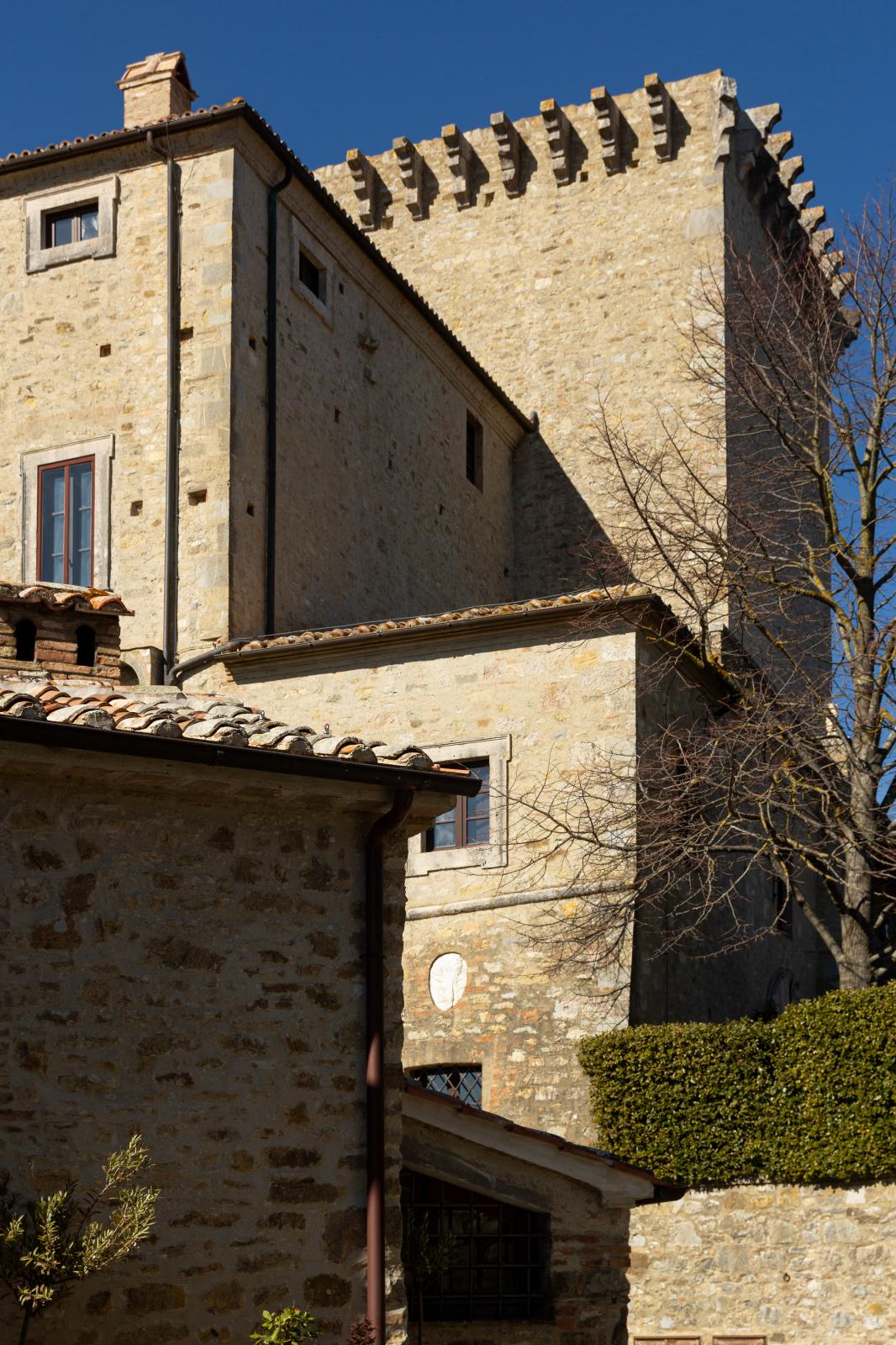
The structure of the great keep is very particular; it conserves the original quadrangular shape with three angle towers: the highest is the ancient nucleus of the fortification and called 'Torre Vecchia' (Old Tower) with a square form and rests of brackets in stone; on the north-east angle there is another tower with an octagonal shape, and the last rises on the north-west side, smaller and semi-octagonal. Attached to this tower started the town walls, and the tower also controlled the unique gate. The walls were approximately 1.5 meters in thickness and endowed with small round towers. Nowadays the town walls, even though in great part ruined, still encircle the village. One of the aforesaid towers was used like the apse of the S.Michele Archangel Church. The portion of the wall where the gate is open seems to rise to its original height with traces of the stone brackets that supported the hoarding. The central body of the fortification, towers, and constable's apartments has strong bastionated walls, united through a dripstone to the vertical part and crowned with brackets.
The S.Michele Archangel Church has the apse turned to the east, according to the ancient tradition, a rectangular plan, a wooden roof, brickwork paving, and two little lateral chapels. In origin it had five altars; today only three. It contains five paintings with images of saints of the 'Scuola Orvietana' and Florence. Behind the greater altar catch the eye the one of S.Michele Archangel, painted by Bonichi of Lucignano in 1750
More info & notes
Photos by Francesco Viti